
Writing Effective Learning Objectives: Key Tips and Examples
Learning objectives are one of those things that sound simple… until you actually have to write them. I’ve been there: staring at a blank doc, trying to capture what I want learners to do, not just what I want them to “understand.” And if you’re teaching (or building training), you already know the real problem—vague objectives lead to messy lessons and assessments that don’t measure what you thought they did.
Here’s the good news. Once you know the pieces to include and the wording patterns that work, writing strong learning objectives gets way easier. In my experience, the moment you start tying objectives to assessment tasks, everything clicks: your activities make more sense, your grading gets fairer, and students stop guessing what matters.
In this post, I’ll walk you through the key components, show you examples that are actually usable (with conditions and criteria), and explain how I align objectives to assessments. I’ll also share the mistakes I’ve seen in real course revisions—and how I fixed them.
Key Takeaways
- Write objectives as observable outcomes: what learners will do, not what you hope they feel.
- Use measurable action verbs (not “know,” “understand,” or “appreciate” without a target behavior).
- Follow SMART—but treat it like a checklist, not a buzzword: clarity, evidence, feasibility, relevance, and a time horizon.
- Include the missing pieces: conditions (“given a dataset…”) and criteria (“with 80% accuracy…”).
- Use an objective-to-assessment map so every test, quiz, or rubric row has a reason to exist.
- Use Bloom’s Taxonomy to sequence difficulty (and to avoid stacking every objective at the “remember” level).
- Review and revise after each term—student performance data will tell you exactly where your wording is failing.

How to Write Effective Learning Objectives
Effective learning objectives do two jobs at once: they guide what you teach and they tell you what to assess. If your objective can’t be assessed, it’s not really an objective—it’s a hope.
Here’s the workflow I use (and I’ve used it on everything from short workshops to semester courses):
1) Start with the outcome, not the topic. What should learners be able to do at the end?
2) Choose a precise action verb that matches the level of learning you want.
3) Add the conditions (what they’re given, what tools they can use, what scenario they work within).
4) Add criteria (how good is “good enough”?)
5) Sanity-check it against an assessment task you could realistically grade.
For example, “understand climate change” is too broad. But “explain the greenhouse effect and its impact on global temperatures” is already closer—because it suggests an observable performance.
Even better, you can tighten it further:
Before: “Students will understand climate change.”
After: “Given a short climate data excerpt (provided in the prompt), students will explain how greenhouse gases affect Earth’s temperature using at least two specific mechanisms from the course materials, scoring at least a 3 on a 4-point explanation rubric.”
See the difference? The second one tells me what to look for, how to measure it, and what “success” means.
One more thing: keep learners’ needs front and center. If your students are new, don’t jump straight to “create a full strategy.” Start with “identify,” “describe,” or “analyze a model,” then build upward.
And yes—when your objectives are clear, alignment gets easier. Your assessments stop feeling like random quizzes and start feeling like evidence.
Key Components of Learning Objectives
If you’ve ever read an objective and thought, “Okay… but how would I test that?”—you’ve found the missing pieces.
A strong learning objective usually includes:
Clarity (plain language)
Keep it specific. Avoid vague terms like “know,” “understand,” or “be familiar with” unless you immediately define what that looks like.
Measurability (evidence you can collect)
Use action verbs that lead to observable work: explain, compare, calculate, design, justify, perform, critique.
Relevance (why this matters for your learners)
Ask: Does this objective match the course level and the real tasks students will face later?
Conditions (the context where learning shows up)
Conditions answer: What resources, constraints, or scenario are included?
Criteria (what “meets expectations” looks like)
This is the part most objectives skip. Criteria can be accuracy targets, rubric levels, word counts, number of required components, or time limits.
If you want a simple template, steal this one:
“Given [condition], learners will [verb] [target] by [criteria], as measured by [assessment method].”
Example condition: “Given a dataset…” “Given a rubric…” “Given a lab scenario…” “Given a draft paragraph…”
Example criteria: “with 80% accuracy,” “including at least 3 evidence points,” “within 10 minutes,” “earning a 3/4 or higher on the rubric.”
When you include conditions and criteria, objectives become usable. Not just readable.
Types of Learning Objectives
People often talk about learning objectives as if they’re all the same. They’re not. A useful way to categorize them is by domain:
Cognitive (thinking and knowledge work)
Examples: summarize, analyze, solve, compare, evaluate, design.
Affective (attitudes, values, and motivation)
Here’s the catch: affective objectives still need observable behavior. “Appreciate diversity” is not measurable on its own. But “justify” and “reflect” can be.
Psychomotor (physical or procedural skills)
Examples: perform a technique, conduct an experiment, assemble a component, execute a routine.
In real courses, you’ll often combine them. In a nursing skills lab, you might have cognitive objectives (interpret vitals) plus psychomotor objectives (perform a procedure) plus affective objectives (follow safety values).
The key is not forcing one domain everywhere—it’s choosing the domain that matches what you’re actually trying to develop.
Examples of Well-Written Learning Objectives
Examples help, but only if they’re detailed enough to copy. Below are objective rewrites that include conditions and criteria, plus what I’d use to assess them.
Biology (Cognitive)
Less effective: “Students will be able to describe the process of photosynthesis and assess its importance to life on Earth.”
More operational: “Given a labeled diagram of a plant cell and a short reading excerpt, students will describe the steps of photosynthesis and assess its importance by writing a 200–250 word explanation that includes: (1) inputs and outputs, (2) where the process occurs, and (3) at least one consequence of reduced photosynthesis. Students must score at least a 3 on a 4-point rubric for accuracy and completeness.”
Assessment method: short written explanation graded with a rubric.
Language Arts (Cognitive + Social/Communication)
Less effective: “Learners will analyze the main themes and character development in the novel ‘To Kill a Mockingbird’ and present their findings in a group discussion.”
More operational: “After reading assigned chapters of ‘To Kill a Mockingbird,’ learners will analyze how two themes develop by citing at least 3 specific textual moments (with page/line references) and present a group summary. The group presentation must last 6–8 minutes and meet rubric criteria for (a) evidence quality, (b) clarity of explanation, and (c) responsiveness to at least two peer questions (minimum 3/4 rubric points each category).”
Assessment method: group presentation rubric + brief Q&A observation checklist.
Professional Training (Affective, made measurable)
Less effective: “Students will appreciate the significance of diversity in cultural narratives.”
More operational: “After reviewing three short narrative excerpts representing different cultural perspectives, students will evaluate how narrative choices shape audience understanding and will write a reflection that identifies at least two potential bias blind spots and proposes one revision to improve cultural sensitivity. Reflections must include both (1) evidence from the excerpts and (2) a concrete action recommendation, scoring at least 3/4 on a reflection rubric.”
Assessment method: rubric-scored reflection with evidence requirements.
That’s the trick with affective goals: you can’t grade “appreciation” directly, but you absolutely can grade the behaviors that show it—just make sure the objective tells you what those behaviors are.
Common Mistakes to Avoid When Writing Learning Objectives
I’ve seen the same issues pop up in course audits again and again. Here are the ones that consistently weaken objectives.
1) Vague verbs
“Understand,” “know,” “learn,” and “be aware of” don’t tell you what learners will actually produce. If you can’t point to evidence, you can’t assess it.
2) No criteria (or criteria that don’t match)
If your objective says “analyze,” but your assessment only asks for a definition, you’ve got a mismatch. Add criteria that match the task you’ll grade.
3) Objectives that don’t connect to assessment
In one course revision I worked on, the objectives were broad and the quiz questions were narrow. Students did fine on the quiz—but didn’t demonstrate the higher-level skills the objectives claimed. The fix wasn’t just rewriting verbs. We rebuilt the objective-to-assessment map and rewrote objectives to include the same scenario types used in the graded tasks.
4) Ignoring the audience level
Writing “create a full marketing plan” for week one is a setup for frustration. Start smaller: “outline,” “compare,” “draft a concept,” then build.
5) Too many objectives at the same level
If every objective is “remember” or “understand,” learners won’t progress. Bloom’s helps you spot that imbalance.
6) Affective objectives without observable behaviors
“Appreciate diversity” is motivational, sure—but it’s not a measurable outcome. Tie it to reflection, justification, evaluation, or action steps.
Finally, don’t treat writing objectives like a one-time task. Revisit them when you review assessment outcomes. That’s where the real improvements come from.
Tips for Creating Measurable Learning Objectives
Measurable objectives aren’t about being complicated. They’re about being specific enough that two instructors would grade the same work similarly.
Tip 1: Start with the performance.
Ask: What will learners do in the assessment? If the answer is “they’ll write something,” then the verb should reflect writing: explain, justify, critique, draft.
Tip 2: Use Bloom’s Taxonomy to pick verbs that match the level.
If you’re not sure which verb fits a level, Bloom’s is a reliable guide. This is also why you’ll see verbs like list/identify for remembering and justify/evaluate for higher levels.
You can use Bloom’s Taxonomy to help select appropriate action verbs and structure progression.
Tip 3: Add conditions.
“Given a case study…” is powerful because it limits what learners rely on. It also makes the assessment fair—everyone works with the same starting point.
Tip 4: Add criteria for success.
Examples of criteria that actually work:
- “with 80% accuracy” (or a specific rubric threshold)
- “including at least 3 evidence points”
- “within 10 minutes” (for timed performance tasks)
- “earning a 3/4 or higher on the rubric”
Tip 5: Match objective complexity to your assessment format.
A multiple-choice quiz can measure some cognitive objectives, but it won’t fully measure “design” or “justify” unless you add constructed responses or performance tasks.
If your objective says “create,” your assessment should involve creation—not just selection.
Do that, and your objectives become actionable. That’s the whole point.
Using Bloom’s Taxonomy in Learning Objectives
Bloom’s Taxonomy is useful because it prevents a common problem: objectives that sound ambitious but stay stuck at the easiest levels.
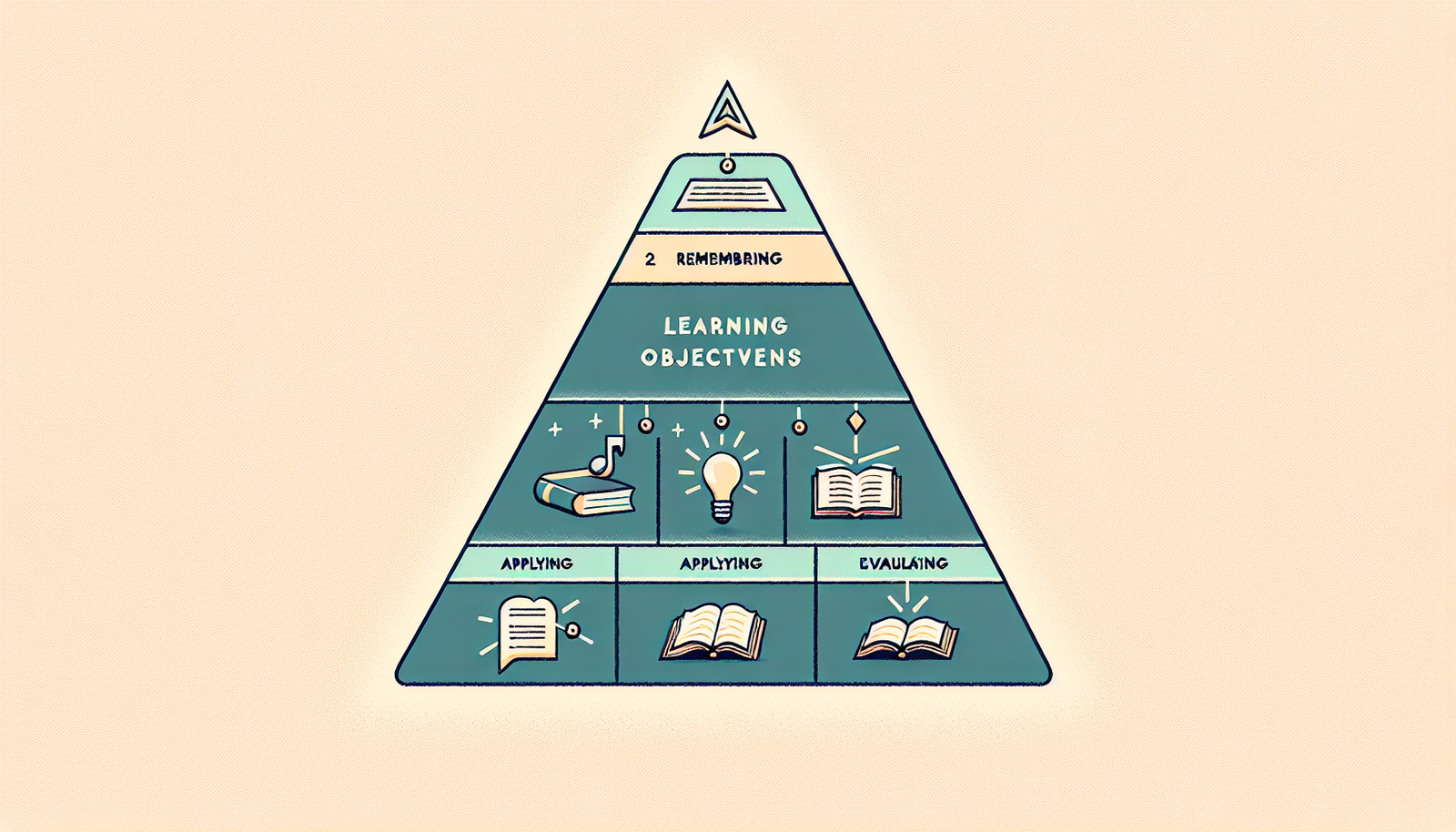
Bloom’s six levels are:
Remembering, Understanding, Applying, Analyzing, Evaluating, and Creating.
Here’s how I use it when writing objectives:
Remembering: “Students will list the key components of a cell.”
Understanding: “Students will explain the function of each component in a cell diagram.”
Applying: “Students will use the diagram to predict what happens when one component is missing.”
Analyzing: “Students will compare two cells and identify which structures support different functions.”
Evaluating: “Students will critique an experiment plan and justify improvements based on variables and controls.”
Creating: “Students will design an experiment to test how light affects plant growth and include a hypothesis, variables, and a measurement plan.”
The progression matters. If you only write “remember” and “understand,” you’ll rarely see strong transfer. But if you scaffold upward, you give learners a path—and you give yourself a clearer assessment plan.
One practical tip: before you finalize your objectives, count them by Bloom level. If 80% are at the bottom two levels, your course may feel repetitive even if the content is “new.”

Aligning Learning Objectives with Assessments
This is the part that separates “nice-sounding objectives” from objectives that actually improve learning.
Here’s the alignment process I recommend:
Step 1: Review each objective and ask, “What evidence would prove this?”
If the objective is “analyze,” the assessment should include analysis work—data interpretation, scenario breakdown, or written critique. A definition quiz won’t cut it.
Step 2: Design (or revise) assessments to match the verb and level.
If you wrote “design,” your assessment needs a design task. If you wrote “evaluate,” you need a judgment task with a justification requirement.
Step 3: Build a quick objective-to-assessment matrix.
Don’t overcomplicate it. Even a simple table works: objectives down the side, assessments across the top, and a checkmark for where each objective is measured.
Step 4: Use multiple assessment types when the skills require it.
- Quizzes for remembering and some understanding
- Short responses for analyzing and justifying
- Projects for applying, evaluating, and creating
- Performance tasks for psychomotor skills
Step 5: Collect feedback and adjust.
After grading, look for patterns. If many students miss the same rubric criterion, your objective may be too vague—or your instruction may not have taught what the objective requires.
In other words: alignment isn’t a one-time checkbox. It’s an improvement loop.
Reviewing and Revising Learning Objectives
Writing objectives once and never touching them is how you end up with stale courses. I treat objective review like version control: small changes after each term make a big difference over time.
Start with performance data. Where did students struggle? What rubric criteria were most often missed? What assessment items produced confusion?
Gather student feedback. Ask questions like:
- “Which objective felt unclear?”
- “Did the activities prepare you for the assessment?”
- “What did you think you needed to do to get a good grade?”
Talk to peers. If another instructor reads your objectives, you’ll catch ambiguity fast. I’ve had colleagues point out verbs that sounded fine to me but weren’t actually measurable.
Watch for standards and learner shifts. If your program changes, your objectives may need updating—especially if the target skills or required competencies changed.
When revising, adjust wording for precision first. Then check alignment again. If you change an objective verb, you may need to tweak the assessment prompt, rubric language, or instructional activities.
Make reviewing a routine practice—end of term, mid-course if necessary—so you’re proactive rather than reacting after grades are already in.
FAQs
Learning objectives are specific, measurable statements that define what learners should achieve by the end of a course. They help you design curriculum and assessments with clarity, so you’re teaching and evaluating the same outcomes.
Use action verbs that describe observable outcomes, and include criteria (like accuracy targets or rubric levels). When possible, add conditions so you’re clear about the scenario and resources learners will use.
Common mistakes include using vague verbs, skipping criteria, writing objectives that don’t match the assessment tasks, and creating affective objectives that don’t include observable behaviors. If you can’t grade it, you’ll need to revise it.
Bloom’s Taxonomy gives you a structure for thinking about learning levels—from remembering up to creating. It helps you choose verbs that match the cognitive demand you want, so your objectives don’t all sit at the same level.