Repurposing Webinars Into Course Modules: 10 Easy Steps
Have you ever spent hours crafting a webinar—slides, examples, even the little “let me tell you a quick story” moments—only to watch it get buried in your audience’s inbox and never really turn into anything bigger? Yeah. I’ve been there.
In my experience, the webinar content isn’t the problem. The problem is that we treat it like a one-and-done event when it can actually become a full course. When you repurpose a webinar into course modules, you’re not just reusing footage—you’re packaging knowledge into a learning path people can follow (and finish).
Below is the exact workflow I use to turn one webinar into a structured course, with templates, a worked example, and the kinds of decisions that keep the end result from feeling generic.
Key Takeaways
- Turn webinar segments into modules by grouping related points into learning objectives (not just “whatever was said”).
- Validate your course topic before you build: keyword demand, audience pain, and competitor gaps.
- Transcribe the webinar, then summarize in a consistent format so you can reliably convert sections into lessons.
- Identify themes and “lesson-worthy” moments (definitions, frameworks, mistakes, examples) for your module list.
- Record modules with decision rules for length (usually 7–10 minutes, but based on objective complexity).
- Use a simple structure: lesson intro → concept → example → practice → quick check.
- Publish with a clear promise: landing page + syllabus + proof (screenshots, outcomes, testimonials).
- Distribute using a checklist: email sequence, social clips, partner shares, and a Udemy-style listing plan.
- Do SEO on purpose: title formula, description template, and keyword placement that matches search intent.
- Update the course based on feedback and completion drop-offs—not vibes.

1. Repurpose Your Webinar Content into Effective Course Modules
Recorded webinars can be a fantastic foundation for course modules. The reason is simple: you already have explanations, examples, and the “why this matters” context baked in.
Also—just to ground this in reality—live webinar conversion rates are often reported around the mid-50% range depending on industry and what “conversion” means (for example, registrants-to-attendees). One commonly cited benchmark is 53–56% for live webinar attendance/registration conversion. (Note: your numbers will vary a lot based on list quality, topic fit, and follow-up.)
Here’s what I do first: I break the webinar into topic blocks that can become modules. Not “five minutes here, five minutes there.” I’m looking for coherent learning chunks.
Quick mapping rule (so you don’t overthink it)
- If a segment answers a learner question (“how do I…?”, “what’s the difference between…?”), it’s module material.
- If it’s a story with a clear takeaway, it becomes an intro example inside a module.
- If it’s pure announcement/promo, it usually doesn’t become a lesson (save it for the course landing page instead).
Webinar-to-course mapping template (copy/paste)
Use this table to turn webinar segments into modules + lessons.
| Webinar Timestamp/Segment | Key Topic | Primary Learner Outcome | Module Title (Draft) | Lesson Objectives (3–5) | Practice/Quiz Idea |
|---|---|---|---|---|---|
| 00:00–07:30 | Problem framing + why it matters | Understand the problem and what “good” looks like | Why This Matters (and What You’ll Build) | Define X, explain Y, identify Z | Quick scenario question |
| 07:31–22:00 | Framework / steps | Apply the framework to a real case | The 5-Step Framework | List steps, map inputs → outputs, avoid common mistakes | Worksheet + 5-question quiz |
| 22:01–35:00 | Example + walkthrough | Replicate the method on your own example | Walkthrough Example | Interpret the example, spot decision points, adapt to constraints | Fill-in-the-blank exercise |
To keep learners engaged, I also build in checkpoints inside each module: a 30–60 second recap, a quiz, and a small action step. It’s not about “adding gamification.” It’s about helping people verify they actually learned something.
If you want more structure around course creation, I refer back to this complete guide to course creation.
2. Validate and Outline Your Course Topic
Here’s the part people skip and then wonder why sales are slow: validating the course topic before you build.
I don’t just ask “is there interest?” I ask: is there enough pain + enough search intent that people will pay to learn it?
How I validate (fast, practical)
- Google Trends: look for upward momentum or at least stable interest over 90 days.
- Search suggestions: type your topic + “how to”, “template”, “for beginners”, “checklist”. If you see consistent suggestions, that’s intent.
- Competitor scan: check what others teach and where their course is weak (too advanced, too theoretical, missing templates, outdated examples).
- Audience poll: ask one direct question: “What’s the most frustrating part of [topic] right now?” Then pick the top answer.
Outline that actually helps you build
Once you’re confident you’ve got demand, outline your course like this:
- Module 1: define the problem + set expectations
- Module 2: teach the core framework
- Module 3: show a worked example
- Module 4: teach common mistakes + fixes
- Module 5: have them practice + review
Then I add a feedback loop. If you can, collect 5–10 short responses from your target audience (survey or DMs). You’re looking for confirmation on outcomes, not agreement on wording.
3. Transcribe and Summarize the Webinar
Transcribing your webinar is one of those steps that feels “extra” until you try to build a course without it. Then you realize: you don’t remember half of what you said.
After transcription, summarize with purpose. The goal isn’t to rewrite the webinar. It’s to extract lesson-ready components.
Chunking method I use (so it doesn’t turn into a mess)
- Chunk by idea: each chunk should contain one concept, one framework, or one example.
- Keep chunk size consistent: aim for 1–3 minutes of spoken content per chunk (or ~150–300 words in text).
- Tag each chunk: label it as definition, framework, example, mistake, or tool.
Summarization template (copy/paste)
- Chunk Title: (one sentence)
- What the learner can do after this: (verb + outcome)
- Key points (3–5 bullets): (no fluff)
- Example(s): (what was shown)
- Common mistake: (what goes wrong)
- Practice prompt: (what they should do next)
Then convert each summary into lesson objectives. If a chunk can’t become at least one clear objective, it probably doesn’t belong as a standalone lesson.
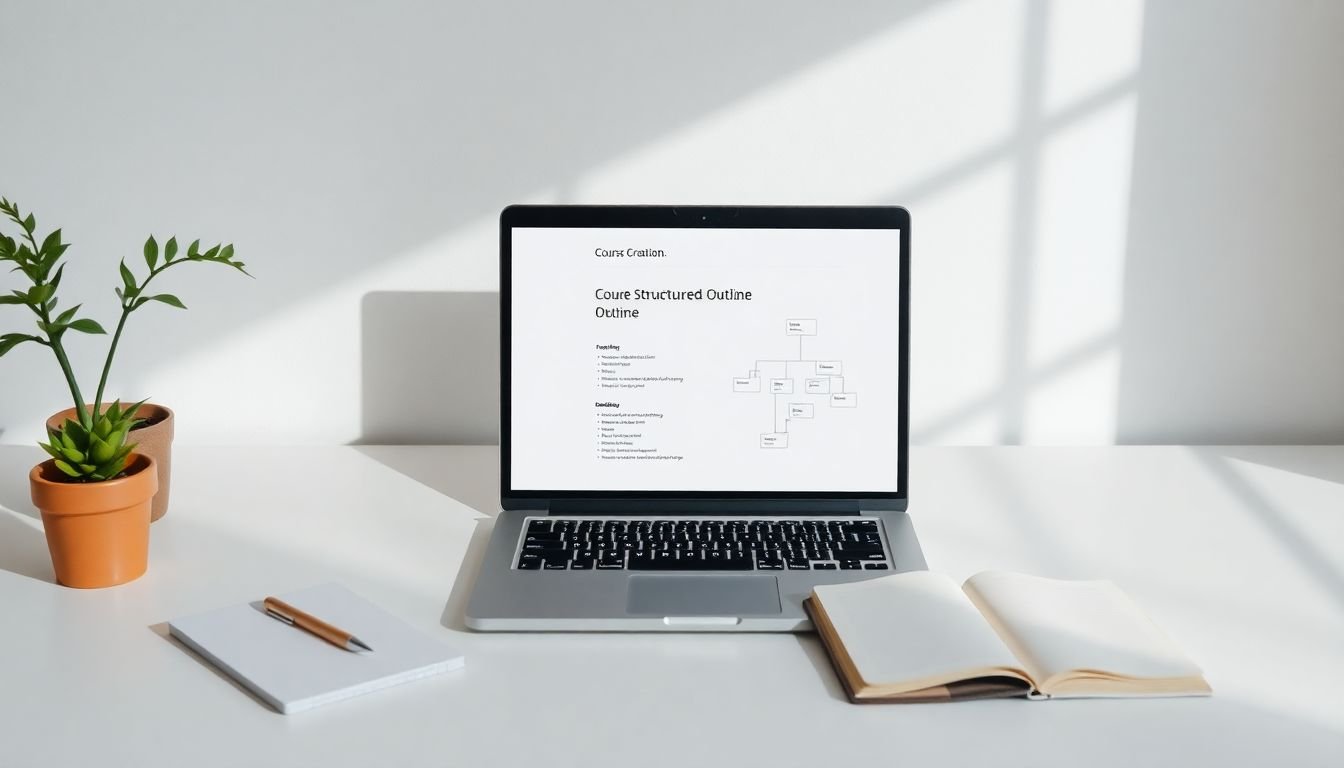
4. Identify Key Sections for Course Creation
This is where you stop thinking “what did I say in the webinar?” and start thinking “what do learners need to practice and remember?”
Go back to your transcription summaries and highlight sections that match at least one of these:
- Definitions: learners can’t progress without a clear meaning
- Frameworks: step-by-step models people can apply
- Mistakes: “here’s what most people do wrong” (this is gold)
- Examples: real-world walkthroughs that remove confusion
- Tools: checklists, templates, or specific processes
Then group them into module-sized sections. If you have a single module idea that’s too big, split it by objective. A module should usually teach one “unit of competence,” not everything at once.
What I mean by “module-sized” (simple test)
- If you can write 3–5 objectives for the section, it’s probably a module.
- If you can only write 1–2 objectives, it might be a lesson inside a bigger module.
If you like visuals, make a quick mind map of themes. It’s faster than it sounds, and it prevents the “why does this lesson feel out of place?” problem later.
5. Create and Record Your Course Modules
Now it’s time to record. But don’t just hit play and talk over your webinar transcript. Your course modules should feel like a guided lesson, not a replay.
Module script outline (the one I actually follow)
- 0:00–0:20: Module promise (“By the end, you’ll be able to…”) + why it matters
- 0:20–2:00: Core concept (definition/framework)
- 2:00–4:30: Example walkthrough (show the “before/after”)
- 4:30–6:30: Practice step (worksheet prompt or mini exercise)
- 6:30–7:30: Quick recap + 3–5 question quiz
Video length decision rules (not a random number)
You’ll often hear “7–10 minutes,” and yes, that range works for many modules. But I decide based on objective complexity:
- 7–9 minutes: one framework + one example + one practice step
- 10–14 minutes: two related concepts or a longer walkthrough with decision points
- Under 7 minutes: definition-heavy lesson with minimal practice
- Over 14 minutes: usually means you should split the module
Worked storyboard example for a 7–10 minute module
- Minute 0–1: Introduce the outcome (what they’ll be able to do)
- Minute 1–3: Teach the framework (3–5 steps)
- Minute 3–6: Walk through one example using the framework
- Minute 6–8: Practice prompt + what a “good answer” looks like
- Minute 8–10: Recap + quiz (5 multiple choice / short answer)
Tools like [Powtoon](https://www.powtoon.com) or [Camtasia](https://www.techsmith.com/video-editor.html) can help with recording and editing. In my experience, the editing job that saves the most time is cutting pauses, removing repeated intros, and tightening the example section.
6. Organize and Structure Your Course Content
Structure is what turns “content” into “learning.” Without it, learners drop off because they can’t predict what comes next.
Start with a clean table of contents:
- Module names should sound like outcomes (“Build Your First X”, “Fix Y Mistakes”).
- Lesson titles should hint at what they’ll do (“Apply the framework to a real case”).
- Every module should include at least one practice or quiz.
Between-module reinforcement (simple but effective)
If you have multiple modules, add:
- One short quiz after each module (5–8 questions)
- One assignment every 2–3 modules (a worksheet, template, or mini project)
- One “review lesson” near the end that summarizes the full path
Platforms like [Teachable](https://teachable.com) or [Thinkific](https://www.thinkific.com) make it easier to organize lessons, quizzes, and downloads without you fighting the UI.
Quiz question bank format (so you don’t reinvent the wheel)
- Question Type: multiple choice / short answer / scenario
- Prompt: 1–2 sentences max
- Correct Answer: (exact)
- Distractors: (why they’re tempting)
- Explanation: 2–4 sentences linking back to the lesson
7. Publish and Market Your Online Course
Publishing is exciting, but marketing starts before launch. I usually treat the landing page and syllabus as part of the course product.
Landing page checklist (what I’d include)
- Headline: outcome + audience (“Learn X to achieve Y—no experience needed”)
- Subheadline: what’s inside (modules) + time commitment
- Bullets: 5–7 outcomes learners get
- Curriculum preview: module list (with lesson titles)
- Proof: webinar results, testimonials, screenshots, or a completion quote
- FAQ: who it’s for, who it’s not for, time, support
- CTA: one button repeated in the layout
Then marketing: pick channels where your audience already is. Social media, email newsletters, and forums are all fair game. I also like offering early-bird pricing, but only if you can actually deliver a better launch experience (bonus lesson, templates, or a live Q&A).
One thing I’ve learned the hard way: don’t just “post and pray.” Track what you send and what converts. UTM links and basic conversion tracking are enough to start.
8. Optimize and Distribute Your Course Content
Distribution isn’t one big blast. It’s a sequence of smaller touches that match how people learn.
Distribution checklist (use this on launch week)
- Day -3 to -1: teaser posts + “what you’ll learn” bullets
- Day 0 (launch): 1 main post + 1 story/reel + 1 email to your list
- Day 1–3: share 3–5 short clips from modules (each clip should teach one thing)
- Day 4–7: publish a blog/resource post that links to the course syllabus
- Ongoing: community prompts + office hours or Q&A
Also, repurpose webinar content into supporting formats: blog posts, social posts, and even podcasts that link back to your course. The key is consistency. If you only publish when you feel motivated, your momentum dies.
If you’re considering marketplaces like Udemy, treat it like a separate listing: update the title/description for that audience and make sure your first lesson hooks quickly.
9. Enhance SEO for Better Discoverability
SEO for courses isn’t just “sprinkle keywords.” It’s matching what people search for with what your course promises.
Keyword set example (so you can see the pattern)
Let’s say your course topic is “Email Marketing for SaaS.” A realistic keyword set might look like:
- Primary: email marketing for SaaS
- Secondary: SaaS email campaigns, onboarding emails, churn reduction emails
- Intent modifiers: template, examples, strategy, for beginners, checklist
Course title formula I recommend
[Outcome] + [Audience/Context] + [Method/What they get]
Example: “Email Marketing for SaaS: Onboarding & Retention Campaigns (Templates Included)”
SEO description template (plug in your details)
First 160 characters: outcome + who it’s for
Then 2–3 paragraphs: what’s inside, who it’s not for, and what learners can do after completion
Finally: list 5–7 outcomes + include 1–2 keyword mentions naturally
Optional but useful: course schema
If your platform supports it, adding structured data (like Course/Organization markup) can help search engines understand the course page. It won’t magically rank you, but it can improve how your course appears in results.
Create a dedicated blog or resource section on your website, too. Helpful articles that link back to your course (and answer specific search questions) can compound over time.
10. Key Takeaways on Repurposing Webinars
Here’s what I’ve noticed after converting multiple webinars into course modules: the winners aren’t the people who “upload a recording.” They’re the people who:
- Turn segments into objectives, not just clips.
- Use transcription summaries to build a real curriculum.
- Record modules with a clear lesson flow (promise → concept → example → practice → check).
- Use quizzes and assignments to reinforce learning and reduce drop-off.
- Market with a landing page that looks like a syllabus, not a sales pitch.
- Optimize SEO using intent-matching titles and descriptions.
If you want, I can also help you map your specific webinar outline into a module plan—just paste your webinar agenda or timestamps.
FAQs
Extract the parts that teach skills (definitions, frameworks, examples), then group them into modules based on learning objectives. After transcribing, summarize each segment and convert those summaries into lesson objectives, quizzes, and practice prompts.
Check interest signals (Google Trends and search suggestions), scan competitors to spot gaps, and run a quick survey or interviews with your target audience. You’re validating outcomes and demand—not just whether people “like” the topic.
Research keyword intent, then use it in your course title, first paragraph of your description, and lesson titles. Write a clear, outcome-focused description, and promote your course via backlinks and social sharing to earn visibility.
Focus on core themes, turn segments into objectives, and add practice so learners can apply what they learn. Then keep improving the course based on feedback and completion patterns.