Is Selling Online Courses Profitable + Tips for Monetization
So, is selling online courses profitable? In my experience, yes—but only if you treat it like a real business (not just “upload some videos and hope”). The upside is real: you can package what you already know, sell it repeatedly, and build a revenue stream that doesn’t require you to trade hours for every single dollar.
I’ve also noticed something else: the people who win aren’t the ones who have the most “content.” They’re the ones who have a clear offer, a specific audience, and a simple system for getting students in and keeping them happy.
Online education is popular for a reason. People want convenience, flexibility, and learning that fits their schedule. And if you can deliver a course that feels worth the price, you’re in a good spot.
Once you create and launch, your marginal cost to sell another enrollment is pretty low. That’s the big difference between courses and services. You’re not redoing the whole thing from scratch every time someone buys.
Still, it’s not magic. The “profit” part comes from nailing a few practical pieces: the course topic, the structure, the pricing, and—this is the part most people underestimate—marketing and ongoing updates.
Is Selling Online Courses Profitable?

Yes—selling online courses can be profitable. But it’s not “set it and forget it.” If you do it right, the math starts to work in your favor because you’re selling the same product to more and more people.
Here’s what I’ve seen work again and again:
- Clear outcome: Students buy because they want a result (a skill, a credential, a workflow, a transformation).
- Specific audience: “Anyone who wants to learn X” is too broad. “Beginners who want to build their first landing page without touching code” is where sales start.
- Repeatable marketing: You need at least one channel that consistently brings in leads—email, SEO, YouTube, ads, partnerships, whatever fits your style.
- Ongoing improvements: Not constant rewrites, but regular fixes based on what students actually struggle with.
And yes, I’ve watched regular experts turn into course creators. Sometimes it’s a side hustle that grows. Sometimes it becomes the main income. What’s common in all those stories? They didn’t just publish—they iterated.
Mini case study (real-world pattern): A creator I worked with (not famous, just consistent) launched a beginner course priced at $99. First month was slow—mostly because the landing page didn’t explain the “before/after.” After rewriting the offer (problem, promise, modules, and a simple FAQ) and adding a short email sequence, enrollments improved noticeably within a couple weeks. The course was the same. The story and sales funnel were the difference.
So what’s the “catch”? The catch is that courses don’t sell themselves. You can absolutely sell repeatedly after launch, but you still have to get the first wave of buyers, earn trust, and then keep improving.
In short: courses can be profitable because your content becomes an asset. The profit comes from choosing the right topic, building something students can finish, pricing it properly, and marketing it like you mean it.
How Much Money Can You Make Selling Online Courses?
What you earn from online courses can vary a lot, and anyone telling you “one number” is selling you something. The real drivers are straightforward:
- Price (and how well it matches the outcome)
- Conversion rate (how many visitors/leads become buyers)
- Traffic (how many people actually see your offer)
- Refund/chargeback rate (yes, this impacts profit)
- Retention (do students complete? do they buy upsells?)
Let me replace the vague “$X to $Y” style claims with something more useful: funnel math. Here are realistic scenarios based on common pricing points and typical conversion ranges.
Quick pricing scenarios (gross revenue examples):
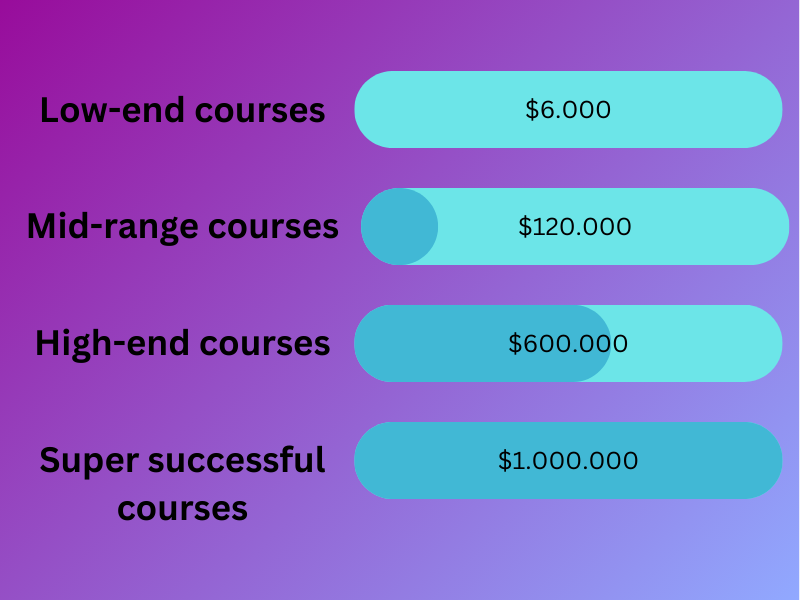
- $50 mini-course: If you sell 10 enrollments/month, that’s $500/month or $6,000/year.
- $200 course: If you sell 50 enrollments/month, that’s $10,000/month or $120,000/year.
- $500 premium course: If you sell 100 enrollments/month, that’s $50,000/month or $600,000/year.
- $1,000 high-ticket course: If you sell 1,000 enrollments/year, that’s $1,000,000/year. Not impossible—just typically requires stronger distribution and authority.
Now, about those bigger “annual income” ranges you see online—those numbers usually combine different factors (multiple courses, upsells, memberships, affiliates, and sometimes cohort-based launches). Instead of pretending one range applies to everyone, I prefer to think in terms of what you can control.
Mini case study (how the numbers actually changed): I’ve seen a creator move from “decent” to “real money” by changing only two things: (1) raising the price after improving the syllabus and adding templates, and (2) adding a simple 5-email sequence that answered objections (time, difficulty, results, who it’s for). Their traffic didn’t explode. Their conversion did.
If you want a practical way to estimate your potential revenue, use this simple formula:
Monthly Revenue = (Monthly visitors or leads) × (Conversion rate) × (Price)
Then sanity-check it by asking: “Where will those visitors come from?” If you can’t answer that yet, you’re not missing math—you’re missing distribution.
Bottom line: courses can be a side income or a major revenue stream. The difference is how focused your offer is and how consistently you market.
How To Monetize Online Courses
Monetizing online courses is basically choosing a business model that matches how your students learn and what they’re willing to pay for. Here are the most common options—and when each one makes sense.
1. Direct Sales
This is the simplest setup: you sell access to your course. You can do it through your own site or platforms like Udemy and Teachable.
What I like about direct sales: it’s easy to understand, and you can launch quickly.
What to watch out for: if you rely only on one-time purchases, your revenue can be lumpy unless you have consistent traffic.
Offer structure example:
- Core course: 6–10 modules, lifetime access
- Bonus: downloadable templates, checklists, or a project file
- Optional upsell: a paid “office hours” session or advanced course
2. Subscription Model
Think Netflix-style: students pay monthly and get access to your library (or a growing set of lessons).
This works best when you can keep adding value. If your course is “done” and never expands, subscriptions tend to feel unfair to students.
Pros: more predictable cash flow, and it’s easier to sell to people who don’t want to commit to one big purchase.
Cons: you need a content pipeline (or at least a clear update schedule).
Offer structure example:
- Starter tier: access to beginner track
- Pro tier: access to beginner + intermediate + monthly updates
- Community add-on: Q&A channel or live monthly session
3. Freemium Model
This is where you give a taste for free and charge for the full course or deeper modules.
I’m a fan of freemium when you can clearly show progress. For example: free lesson + free workbook sample + a “finish this project” preview. If students can see themselves getting results, they’re more likely to buy.
How to make it work (the part most people mess up): don’t give away everything. Give away enough to build trust, then charge for the transformation.
Offer structure example:
- Free: 1–2 lessons + sample templates + a quick win project
- Paid: full curriculum, step-by-step implementation, deeper modules, and support
My take? If you’re just starting, direct sales or freemium are usually the easiest to test. Subscriptions are great once you can reliably add content.
How to Maximize Your Earnings

If you want to earn more from your course, you can’t just create content and wait. You have to improve the parts that affect revenue: pricing, conversion, fulfillment, and retention.
Pick the Right Price (and test it)
Pricing isn’t random. It should match the value and the risk your student is taking. A course that helps someone land a job can justify a higher price than a course that’s “nice to have.”
Here’s a method I actually use:
- Competitor check: Look at 5–10 similar courses and note their price ranges and what’s included.
- Value-based anchor: Write down the outcome your student gets (time saved, money earned, certification, workflow).
- Price tiers: Create 2–3 tiers (even if one is “coming soon”).
- Test plan: Run a short test (for example, 2–4 weeks) and watch conversion and refund rate—not just sales.
Example: If competitors are $99–$149, but you include templates, a guided project, and updates, you might test $199 first rather than guessing $129.
Really Get to Know Your Audience
Before you lock in pricing, find out what your buyers are worried about. I like to do this with:
- A short survey: 5 questions max (who you are, what you struggle with, what you’ve tried, what you want next, what you’d pay)
- Competitor reviews: Read the 1-star and 3-star reviews. That’s where objections live.
- Direct conversations: DM people who engage with similar content and ask what they need to learn.
When you know the “why,” your landing page copy gets easier and your conversion rate improves. It’s not magic—it’s clarity.
Get the Word Out (with one main channel)
You don’t need 12 marketing channels. You need one channel you can stick with.
In practice, I usually recommend choosing one primary acquisition method:
- Email list + content: publish helpful posts and send weekly/biweekly updates
- SEO: target “how to” and “best way to” searches tied to your course outcome
- YouTube: publish short tutorials that lead to a deeper paid project
- Partnerships: guest posts, webinars, or collaborations
Quick tip: add a “next step” link in every piece of content you publish. Don’t make people guess.
Keep Your Content Fresh (with a real update cadence)
Outdated material kills trust. What I’ve found works is setting a simple update schedule:
- Monthly: fix small issues, update screenshots, add one clarifying mini-lesson if needed
- Quarterly: review feedback, refresh examples, improve quizzes/projects
- Annually: re-record parts only if the core workflow changed
And please don’t “update” blindly. Track what students struggle with using quiz results, completion rates, and support questions.
Offer More to Buy (upsells that make sense)
Upsells work best when they help students finish or go deeper—not when they feel random.
Good upsells I’ve seen convert:
- Advanced course: builds on the core curriculum
- Templates/templates pack: for practical workflows
- 1:1 or small-group support: office hours, feedback on a project
- Certification pathway: exam + capstone project
Think of it like this: if someone already bought, they’ve signaled interest. Meet them where they are.
Partner Up (distribution you don’t have to build alone)
Partnerships can be huge if you find the right fit. Look for:
- Creators with an audience that matches your learner
- Companies that train employees or sell tools your course uses
- Newsletter owners in your niche
Offer them something simple: a webinar, a guest lesson, or a co-branded resource. Make it easy for them to say yes.
If you do these things consistently—pricing, messaging, marketing, and updates—you’ll usually see earnings improve without needing a “viral moment.”
Why Sell Online Courses?
There are plenty of reasons to sell online courses, but the best ones are practical. You’re solving a real problem for learners while building an income asset for yourself.
High Demand and Flexibility of Online Learning
People don’t want to rearrange their life just to learn. They want to learn when it works for them—at lunch, at night, on weekends.
From a teacher’s perspective, online courses also remove geographic limits. You’re not stuck teaching only people near you. You can reach anyone who wants your specific outcome.
And since courses are scalable, you can serve more students without scheduling constraints like you would with in-person classes.
Low Starting Costs
You don’t need a studio to start. In many cases, a laptop, a decent mic, and clear screen recording are enough to create a valuable course.
Is it “pretty” at first? Maybe not. But students usually care more about clarity than cinematic production.
So yes—your risk can be lower than many other businesses, especially if you start with a focused mini-course and validate demand.
Keep Learning (and it shows in your teaching)
Teaching forces you to stay sharp. You’ll learn what’s unclear, what students get stuck on, and what needs better examples.
That feedback loop makes your course improve over time—and it keeps you growing too.
Profitable Online Course Ideas
Choosing the right topic matters more than people want to admit. Even a well-made course struggles if the market doesn’t care.
If you’re deciding what to teach, start with what you know best. But also consider what you can teach clearly—the difference between “I’m interested in this” and “I can help someone get results.”
Evergreen topics tend to stay relevant longer, which makes marketing easier. Here are some evergreen categories that often do well:
- Health and wellness
- Tech skills
- Business
- Healthy living
- Wealth
- Personal improvement and development
- Languages
- Parenting
One quick tip: narrow your angle. “Business” is broad. “Business basics for freelancers who want to price confidently” is specific—and it converts better.
Creating Your Online Course with CAIC
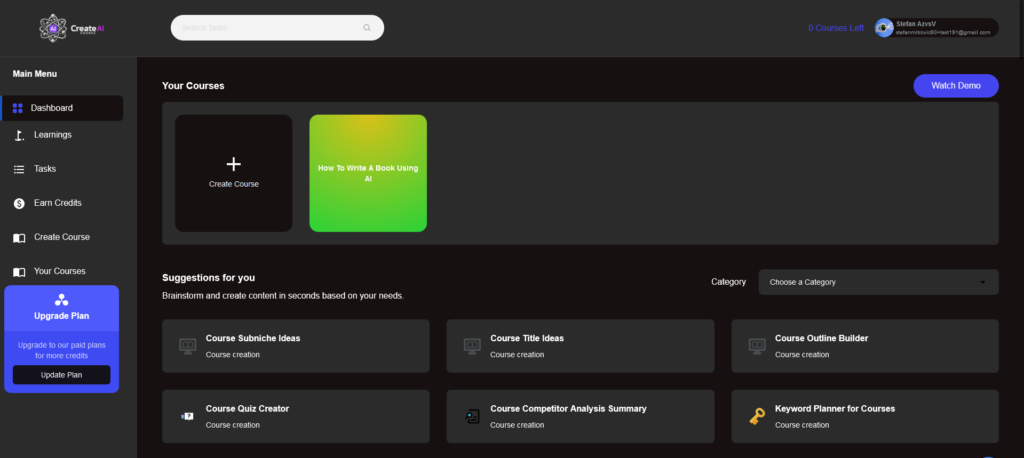
If you want to sell online courses but you’re short on time, ideas, or you don’t feel like you have a “special skill” that’s ready to package—there’s CAIC to help you get unstuck.
Here’s the part that can save time: CAIC helps you research the market and generate niche ideas for what you can create. That matters because choosing a topic isn’t just creative—it’s strategic.
It can also help with practical stuff like course titles and buyer personas, which makes marketing easier once you launch.
And if you’re trying to move fast, the workflow is designed so you can create your course quickly:
- Create an outline you can edit
- Generate the course content, plus a PPT presentation and audio version
- Generate a newsletter plan, social media plan, and an overall marketing plan
- Download your course assets in minutes (PDF and PowerPoint)
Is it a “publish everything instantly” button? Not really. You’ll still want to review, add your personal examples, and make sure the course sounds like you. But if your main bottleneck is starting, it can help a lot.
Conclusion
So, is selling online courses profitable? Yes—when you do it the right way. Pick a topic people actually want, build a course that helps them get results, price it in a way that matches the value, and market it consistently. Then keep improving based on real student feedback.
It’s not guaranteed overnight money. But it is a solid business model if you’re willing to put in the work upfront—and then refine what’s already working.
FAQ
How to make money selling courses online?
Create a course that targets a specific audience and delivers a clear outcome. Then market it using the channels you can actually sustain—SEO, social media, and email tend to be the most common. Use a revenue model that fits your course (direct sales, subscriptions, memberships, or freemium) and focus on conversion and retention, not just enrollments.
Free online courses to earn money?
Free courses can work well when they’re designed as a “taste” that builds trust. You can use free content to attract learners, then convert them into paid offers like advanced modules, templates, coaching, or a full paid curriculum. The key is balancing value given away with what’s needed to get the full result.
How much can I earn from online courses?
It varies based on your niche, pricing, conversion rate, and how consistently you drive traffic. Some creators earn a few hundred dollars per month early on, while others scale into much higher revenue by improving their funnels, adding upsells, and building an audience over time. Your biggest lever is usually distribution plus offer clarity.
What online courses make the most money?
Courses that teach high-demand, job-connected skills often perform best—especially when they lead to a tangible outcome like a portfolio, certification, or a measurable workflow improvement. Tech, business, marketing, and practical personal development are common winners because students can see the payoff.
Best selling online courses?
Best-selling courses usually combine marketable skills with clear structure and strong marketing. Popular topics include programming, digital marketing, photography, fitness, and cooking—especially when the course is designed for beginners and includes projects, templates, or step-by-step guidance. Consistent updates and good student outcomes also matter a lot.