
How to Design Branded Icon Sets for Course Modules in 5 Steps
If you’ve ever stared at a blank course page thinking, “How am I supposed to make these modules feel consistent?” you’re definitely not alone. Icon sets can look simple, but the moment you try to match your brand across lessons, quizzes, assignments, and progress tracking… things get messy fast.
What I’ve found is this: a branded icon set isn’t just decoration. When it’s done well, icons become quick navigation cues. Students don’t have to read every label to understand what’s what—they recognize patterns. And when it’s done poorly? They feel like random clipart, and learners hesitate.
In this post, I’ll walk you through a practical 5-step process I use to design branded icon sets for course modules. I’ll also show you what to test, what to standardize, and how to avoid the most common “looks good in Figma, breaks in the LMS” problems.
Here’s what you’ll cover: defining your icon style, picking icons that match each module element, implementing them consistently, customizing them inside your LMS (or course platform), and testing for usability + accessibility. After that, I’ll share a few bonus tactics I’ve used to make icons feel intentional instead of noisy. Ready?
Key Takeaways
- Pick one icon style (outline, filled, or flat) and lock it in. Mixing styles “a little” usually ends up looking inconsistent.
- Choose icons based on module function (reading, assignment, discussion, quiz, completion), not vibes. If a learner can’t guess it in 2 seconds, it’s too vague.
- Standardize size, stroke weight, spacing, and placement with a mini style guide so every module page stays visually predictable.
- Customize icons inside your LMS/platform (upload SVGs, set icon dimensions, control spacing with CSS if available) so they don’t blur, clip, or shift.
- Test with real people on real devices. Use acceptance checks like contrast (WCAG AA: 4.5:1 for normal text) and “recognition in under 2 seconds.”
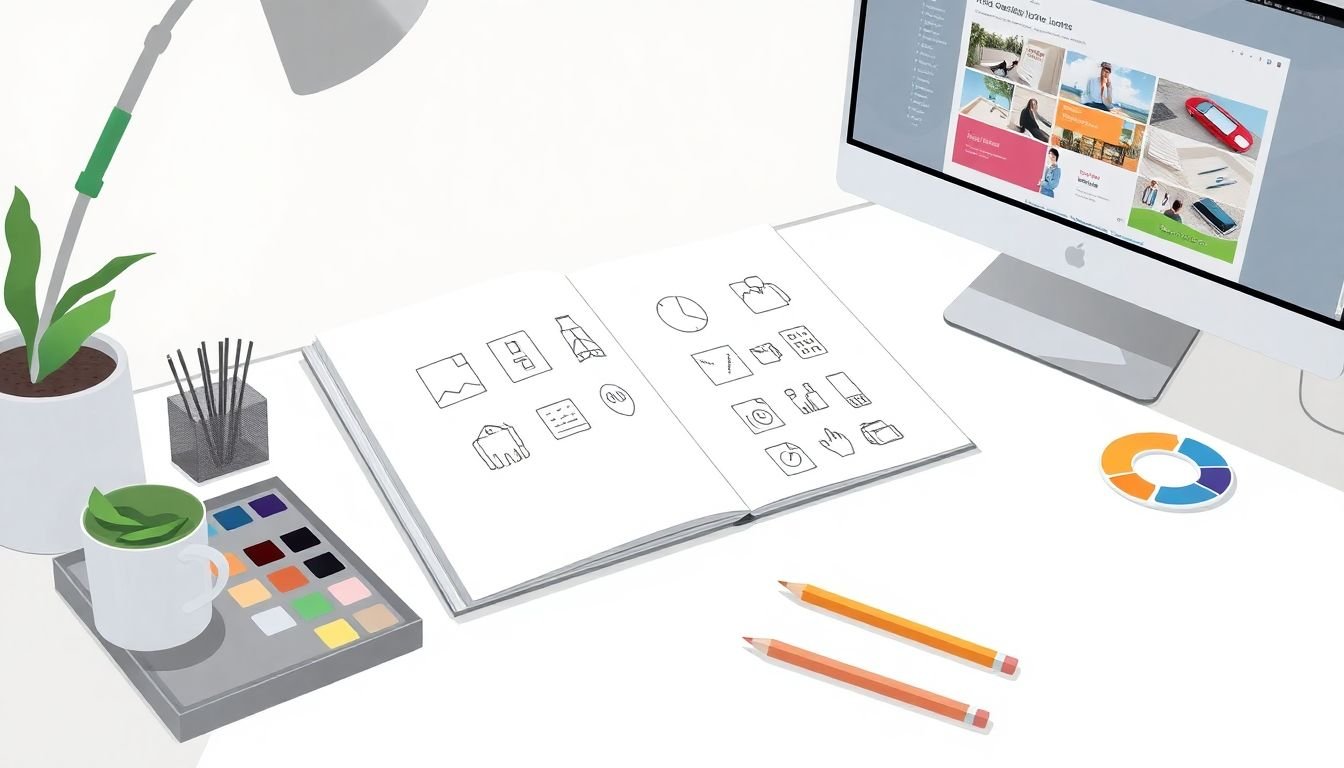
Step 1: Define Your Icon Style and Visual Brand
Start with the icon “language.” If your course branding is sleek and minimal, don’t grab chunky icons just because they’re cute. I usually decide on one style first: outline, filled, or flat. Then I build everything from that single decision.
What I’d do in practice:
- Choose a style: Flat icons are a safe bet for e-learning because they stay readable when scaled down.
- Lock a color palette: pick 2–3 colors max. For example: a primary brand color for icons, a neutral for secondary icons (or outlines), and maybe one accent color for “status” (like completed).
- Set stroke/weight rules: if you’re using outline icons, pick one stroke weight and stick to it. If the icons don’t look consistent at 24px, they won’t magically fix themselves later.
- Match your brand voice: playful brands can use rounded corners and softer shapes; professional brands should keep corners crisp and proportions consistent.
Here’s a quick mini style guide template I use (copy it into a doc and fill it in):
- Canvas/grid: 256px or 512px artboard, grid on
- Icon size targets: 16px (small), 24px (default), 32px (emphasis)
- Stroke weight: 2px at 24px icon size (example—use what matches your set)
- Corner radius rules: rounded corners only if the brand is rounded
- Safe margins: keep 10–12% padding inside the 24px box so icons don’t feel cramped
- Color usage: primary icon fill = brand primary; status icons = accent; disabled states = 60% opacity neutral
For tools, I’ve had good results with canva for quick tweaks and Figma when I need precise alignment and SVG export. The key is exporting clean SVGs (more on that in Step 4).
One more thing: don’t decide your icon style after you’ve already placed 20 icons. I learned that the hard way—switching styles mid-course is a “redo everything” kind of pain.
Step 2: Select Meaningful, Clear Icons for Module Elements
This is where most icon sets fail. People pick icons that “look right,” but not icons that mean something instantly.
I recommend you build an icon-to-module map before you design anything. Think of it like taxonomy: each icon needs a job.
Example mapping (works well for course modules):
- Reading / Lesson: book or document icon
- Video: play button inside a screen
- Assignment: pencil/edit or clipboard
- Quiz: question mark in a circle or checkered flag
- Discussion: chat bubble
- Resources / Download: folder with arrow
- Progress / Completion: checkmark or badge
- Announcement: megaphone
Now, let’s make it concrete. Suppose you have a module titled “Week 3: Research Methods”. In that module, you might include:
- “Lecture Notes” → book/document icon
- “Worksheet” → clipboard/edit icon
- “Practice Quiz” → question/check icon
- “Download Sources” → folder/download icon
If a learner can’t understand those in a quick glance, you’ll see confusion in behavior—people click around, hesitate, or skip content. That’s the real cost.
My clarity rule: test recognition at 24px (and again at 16px if your LMS is tight). If the icon’s meaning isn’t obvious in about 2 seconds, simplify it. More details don’t help at small sizes.
Also, don’t rely on color alone. If you’re using color to represent status (like “completed”), make sure the shape communicates it too (checkmark, badge, or filled vs outline).
Step 3: Implement Icons Consistently Across Modules
Once you’ve got the right icons, the next step is making sure they behave consistently across every module page. This is where a style guide saves you from yourself.
Consistency checklist (the stuff that actually matters):
- Same icon style everywhere: if icons are outline in lesson cards, they shouldn’t suddenly be filled in quizzes.
- Same size for the same purpose: for example, lesson icons always 24px; status icons always 20–24px; section headers always 32px.
- Same alignment: top-aligned icons can look “off” next to multi-line titles. Choose one alignment and stick with it.
- Predictable placement: I prefer icons next to titles (not floating above), because students scan left-to-right.
- Spacing rules: decide the gap between icon and text (example: 8px at desktop, 6px at mobile).
Here’s a real-world implementation detail that made a difference for me: I standardized two icon sizes instead of trying to be fancy with 5 sizes. The UI stopped feeling “random.”
Before/after example:
- Before: lesson icons at 28px, quiz icons at 22px, resources at whatever looked “close.” Result: students noticed the inconsistency more than the content.
- After: lesson + quiz icons both at 24px, resources at 24px, section header icons at 32px. Result: the course felt cleaner and more intentional.
One more tip: batch upload or apply icons in bulk when you can. If you place them one-by-one, you’ll accidentally vary spacing, sizes, and color codes.
Finally, do a quick sweep after updates. Even small changes to your theme or typography can shift icon alignment. A 5-minute QA pass prevents “why does this look different?” headaches.

Step 4: Customize Icons in Your LMS or Course Platform
Now comes the part people skip: getting icons to behave inside your LMS. This is where SVGs get resized weirdly, colors don’t match, and “it looked fine in the design tool” turns into a real issue.
Most platforms like Teachable or Thinkific let you customize course elements, but the exact workflow varies. What I do first is check:
- Can I upload SVGs? If yes, do it. SVG keeps icons crisp at any size.
- If not, can I upload PNGs? If you must use PNG, export multiple sizes (16px/24px/32px) so they don’t blur.
- Does the platform support custom HTML/CSS? If yes, I use CSS to control icon size and spacing consistently.
Icon size target (practical): if your icon appears next to lesson titles, aim for 24px icon size. If it’s in a section header or big callout, use 32px. If you’re trying to go smaller than 16px, you’ll lose recognition for many learners.
Color matching matters too. If your brand primary is, say, a deep blue, don’t let the LMS replace it with default link blue. I usually test both a light background and a slightly tinted card background, because contrast can change fast.
If your platform allows CSS, here’s the kind of rule I look for (conceptually): set the icon container width/height, then force the SVG to fit without clipping. You want consistent padding and no “mystery cropping.”
And yes, placement can be different across modules. Try icons in:
- lesson cards
- section headers
- buttons (like “Start Quiz”)
- progress indicators
If you’re also building educational content in general, you can reference how-to-create educational content for how I think about structure—icons should support clarity, not compete with the lesson.
Step 5: Test for Usability and Accessibility
Before I ship an icon set to a live course, I test it with real humans. Not “my friend who says it looks cool.” I mean actual recognition + usability checks.
My quick test plan (5–8 people):
- Give them 10–15 seconds per screen. Ask: “What do you think this icon means?”
- Record incorrect guesses (even if they’re close). That tells you the icon is too abstract.
- Test on at least two device sizes: a phone (narrow) and a desktop (wide).
Accessibility checks I actually care about:
- Contrast: if icons are used as meaningful cues, make sure they have enough contrast against the background. For text, WCAG AA is 4.5:1 (normal text). Icons aren’t always measured the same way, but the principle holds: low contrast icons fail in real life.
- Don’t rely on color only: if “completed” is green, also use a checkmark/badge shape.
- Text labels: if your LMS supports it, add labels near icons (or on hover). Icons should clarify, not replace meaning.
- Screen readers: if icons are decorative, mark them as decorative. If they convey meaning, ensure they have an accessible name (alt text or ARIA label depending on how the LMS renders them).
Here’s a limitation I’ll be honest about: you can’t fully “accessibility-proof” icons in isolation. The same icon might be fine on one theme background and unreadable on another. That’s why device + theme testing matters.
For more on writing and structuring learning content (so icons don’t become the only way to understand things), check out lesson writing best practices.
Bonus Tips: Enhancing Icon Use for Engagement and Visual Interest
If you want icons to feel engaging (not just functional), I like using them in a few specific places:
- Highlight key actions: star icon for “Top Tip,” megaphone for “Announcement,” checkmark for “Completed.”
- Use icon groups for pathways: for example, a small row like “Watch → Worksheet → Quiz” helps learners understand the flow instantly.
- Break up dense sections: if a module has 6 paragraphs of text, one icon per subheading makes scanning easier.
Animated icons can be fun, but I’m picky here. I only use subtle animation for status (like a gentle pulse on “New Assignment”). If everything animates, nothing stands out—and you end up with visual noise.
Also, don’t overdo it. Icons should support learning. When students feel like they’re decoding a visual system instead of learning the content, you’ve gone too far.
If you’re pairing icons with other learning elements, quizzes and badges are a great example of how icons can reinforce motivation without adding extra cognitive load.
Best Practices Recap for Designing Branded Icon Sets
Here’s the short recap I keep coming back to:
- Pick one icon style: outline, filled, or flat—and stick to it.
- Limit your palette: 2–3 colors. Use the accent color only for status or emphasis.
- Use recognizable symbols: if learners can’t guess the function quickly, simplify.
- Standardize sizing + spacing: decide on 24px for most UI icons and 32px for headers/callouts, then keep it consistent.
- Plan for accessibility: contrast, text labels, and screen reader-friendly naming.
- Test on real devices: phone + desktop at minimum, and check how icons look on your actual LMS theme.
If you’re also thinking about the overall course setup and where icons will live, you may want to revisit comparing online course platforms so you’re designing within the constraints you’ll actually have.
FAQs
The first step is defining your icon style and setting a visual brand baseline. That’s what keeps your icon set consistent across lessons, quizzes, and navigation so it feels like one cohesive product—not a patchwork of graphics.
Choose icons based on the module’s function. For example, use a book/document for reading, a play icon for video, and a checkmark/badge for completion. If someone can’t guess the meaning in a couple seconds at 24px, the icon is probably too abstract.
Consistency is the big one. Use the same style and sizing rules across similar UI elements, and place icons in predictable locations (like next to titles or inside navigation items). That’s what builds learner familiarity.
Test for usability and accessibility by ensuring strong contrast, using text labels when icons represent meaning, and making sure icons are properly labeled for assistive technologies. Don’t assume “it’s obvious” just because it’s obvious to you.