
Courses Using Immersive Learning Techniques: How to Choose
Let’s be honest—most courses feel like they were designed to put you to sleep. If you’ve ever sat through a “slide after slide” deck, you know the problem: you’re reading facts, not using them. And then the moment you’re back at work (or home), the content you studied just… vanishes.
That’s why I’ve leaned more into immersive learning techniques lately. They don’t just show information—they put learners inside the situation so they can practice, make decisions, and learn from mistakes without real-world consequences. In my experience, that’s when training starts to feel worth the time.
So how do you choose the right immersive course type? Keep reading—I’ll walk you through the best options and the decisions I use to pick what fits.
Key Takeaways
- Pick immersive learning options based on your goal: use VR simulations for high-stakes practice, AR for “do it on the real thing,” and MR/360° for context-heavy learning.
- For workplace safety and compliance, gamification works best when it’s tied to real scenarios (near-misses, checklists, incident reporting), not just points and badges.
- AI-enhanced sales training shines when reps get role-play practice with realistic branching responses and clear scoring/rubrics for improvement.
- For STEM, anatomy, and language learning, interactive 3D and scenario-based practice beat passive content—especially when learners get feedback right away.
- Keep lessons short and structured: I usually aim for 10–20 minute immersive segments with an objective, a scenario, a debrief, and a quick assessment.

Top Courses Using Immersive Learning Techniques (and how to choose)
Immersive learning isn’t automatically better just because it’s “cool.” What matters is whether it matches your learning objective and constraints (time, devices, risk level, and assessment needs).
In my experience, the easiest way to choose is to start with four questions:
- What do learners need to do? (Perform a task, make a decision, speak, identify parts, follow a procedure.)
- How risky is it to practice? If mistakes are expensive or dangerous, VR simulations are usually the safer bet.
- What hardware do you actually have access to? If you don’t have headsets, AR on mobile or 360° video may be the realistic starting point.
- How will you measure success? If you can’t score performance (checklists, rubrics, branching outcomes), immersive content can turn into “engaging but not measurable.”
Now, here are the immersive course types that tend to work well—and when you should pick each one.
One reason VR gets so much attention is that it can improve training outcomes compared to traditional methods. For example, PwC has published work on the metaverse and emerging technology that discusses VR training benefits (and I recommend reading the full source for your exact use case rather than relying on a single headline number). If you want a starting point, review the PwC page here: PwC metaverse survey.
Let me make this practical: if you’re training pilots, firefighters, or maintenance staff, you can’t always simulate real emergencies. Flight simulators are a perfect example—learners practice emergency procedures repeatedly, then debrief on what happened and why. That loop (scenario → action → feedback) is where the learning sticks.
For technical work like repairs, AR usually beats VR. With AR, I’m able to overlay steps directly on the object in front of you. It’s basically “instructions that know where you are,” and that reduces the back-and-forth of interpreting diagrams.
Whatever modality you choose, don’t overstuff it. Immersive lessons work best when they’re goal-focused and short enough to keep attention. A structure I like is:
- Objective (1–2 minutes): what learners must be able to do
- Scenario/Task (10–20 minutes): guided practice with branching choices
- Debrief (3–5 minutes): what worked, what didn’t, and the “why”
- Assessment (5–10 minutes): quick quiz, checklist, or performance score
And yes—sometimes learners need a little “play” time at the start. But the play should lead somewhere, not replace instruction.
Virtual Reality Field Trips and Exploration Courses
Field trips are exciting because they break the routine. VR field trips try to recreate that feeling without the transportation headache. In a classroom, I’ve seen engagement jump when students can explore places they’d never reach—ancient ruins, deep-sea environments, or even space—without needing special logistics.
The big difference from a regular video is interaction. Students don’t just watch Mars; they look around, move through the environment, and make choices about what to inspect next. That turns passive viewing into active exploration.
Here’s what makes VR field trips actually effective (not just entertaining):
- Send objectives beforehand. Example objectives: “Identify 3 features of coral reefs that support marine life” or “Find evidence of human activity in this ruin.”
- Use in-VR prompts. Give learners tasks like “collect” an artifact, take a measurement, or answer a question at a specific location.
- Debrief immediately. Ask what they noticed and connect it to the lesson you planned.
- Assess right after. A short checklist or 5-question quiz beats “discussion only” every time.
Platforms like Google Expeditions or Nearpod VR can help you get started with pre-made trips. The selection criteria I use are simple: device compatibility, content licensing, teacher controls (can you edit objectives?), and analytics (can you see completion or answers?).
If you need something specific to your curriculum, you’ll likely want custom content. In that case, planning the learning objectives first is what saves you time later—otherwise you end up with beautiful VR experiences that don’t align to your outcomes.
Gamified Safety and Compliance Training for the Workplace
Safety training can feel like a punishment. People know they “should” pay attention, but it’s hard when the material is generic and never connects to real situations they face.
That’s where gamified immersive training helps—when it’s scenario-driven. Leaderboards and badges are fine, but they’re not the point. The point is that learners practice making decisions under pressure and learn the consequences of skipping steps.
Regarding the confidence-stat claims you may see online: I don’t like repeating big percentages unless they’re clearly tied to a specific metric, population, and report context. PwC has published materials on metaverse and emerging technology that discuss survey findings, but the safest approach is to use those sources directly and map the metric to your own training outcomes. Use the PwC page as a reference point: PwC report page.
Here’s what I’d look for when choosing a gamified safety platform (or building your own):
- Realistic scenarios (near-miss, lockout/tagout, PPE checks, incident reporting)
- Clear scoring (checklist-based scoring or rubric-based feedback)
- Repeatable practice so learners can retry and improve
- Manager-friendly reporting (who completed what, where they struggled)
- Accessibility (can it run on common devices without heavy setup?)
Tools like Axonify or EdApp can be useful if you want ready-made gamification and compliance content. In my mind, the best use case is onboarding and annual refreshers—because employees need repetition, and gamification makes repetition less painful.
If you’re building your own lessons, pair the game mechanics with solid teaching structure. If you want a starting point, check our guide on effective teaching strategies by searching within AICoursify for teaching strategy resources (and don’t skip the debrief step—debrief is where “fun” becomes “learning”).
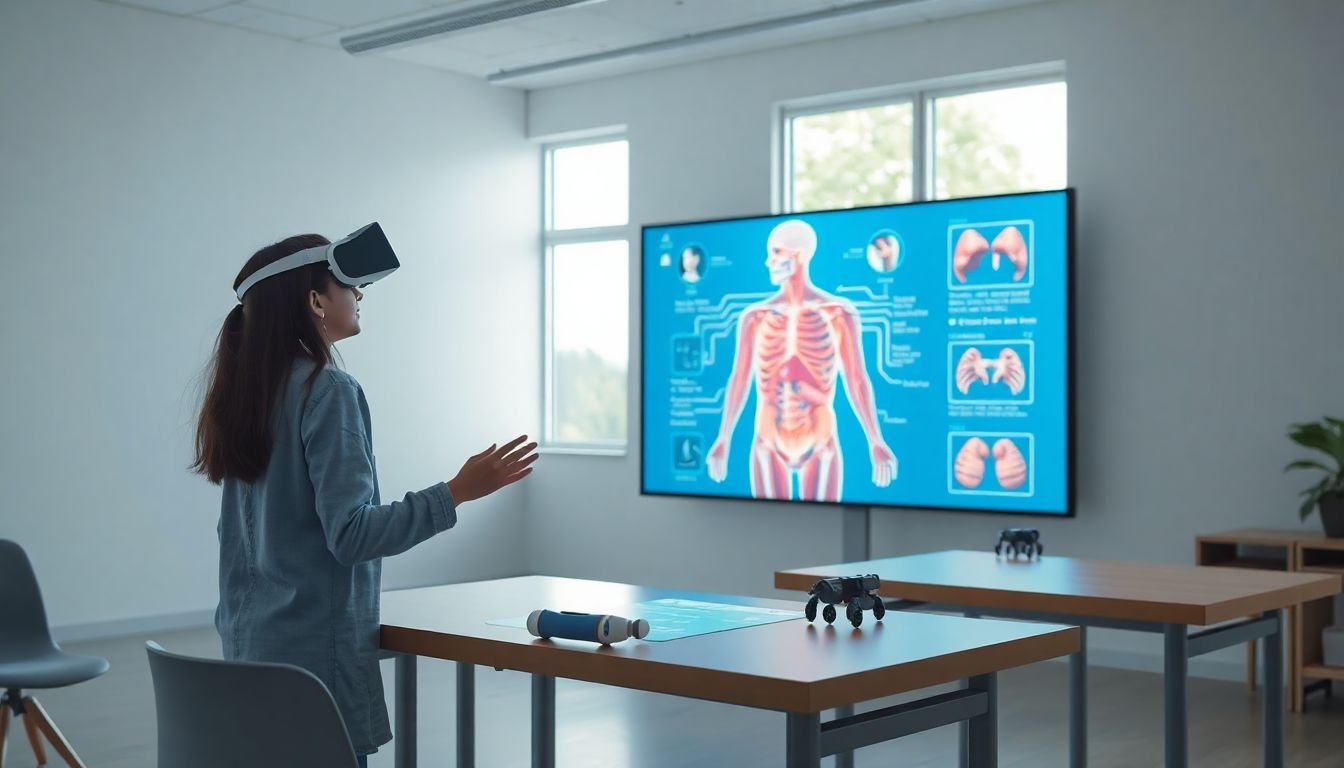
AI-Enhanced Sales Training Programs
If you’ve ever trained sales reps with “script reading” and generic role-play, you already know the problem: it doesn’t feel real. People can recite the line, but they freeze when the customer pushes back.
AI-enhanced immersive sales training fixes that by running realistic conversations where responses adapt to what the rep says. In other words, the rep can’t just memorize— they have to think.
Tools like Mindtickle or Allego are examples of platforms that support AI-driven scenarios and feedback loops. When I evaluate this category, I focus on a few practical things:
- Branching quality: does the scenario actually change based on choices, or is it “choose A or B” with no nuance?
- Feedback that’s usable: does it point out what to improve (tone, objection handling, discovery questions)?
- Scoring/rubrics: can you measure progress over time?
- Time-to-practice: can reps do it in 5–10 minute sessions?
One tip I really like for sales: don’t schedule a single long training session. Instead, do short daily practice. Even 3–5 minutes a day adds up fast, and reps stay in the “active” mindset.
STEM and Coding Immersive Learning Camps for Kids
Keeping kids interested in STEM is hard—mostly because the moment it feels like homework, they’re out. Immersive learning helps because it turns skills into something they can build, test, and improve.
In camps, the best experiences give kids immediate feedback. They write code, change something, and instantly see the result. That feedback loop is what makes “practice” feel like play.
Platforms like Roblox Education or CodeCombat can support immersive-style learning environments where kids build worlds, solve puzzles, and learn coding fundamentals through challenges.
When you’re planning a camp, set goals that are achievable in a single session. For example:
- Session goal: “Build a character that can jump and collect 10 coins”
- Next goal: “Add a timer and scoring system”
- Final goal: “Create a simple level with win/lose conditions”
Then wrap it up with a reward that makes sense (badges for milestones, team challenges, or “show your build” time). Motivation matters. But more importantly, clear goals keep the learning from getting messy.
Mixed Reality and 360° Video Learning Experiences
Mixed reality is a strong fit when learners need context—like working around real equipment, understanding spatial relationships, or practicing steps that depend on what’s in front of them.
360° video is often the more accessible option when you need “immersion” without expensive device setups. It’s also great for storytelling: you can place learners inside a moment and let them look around, then follow up with questions and tasks.
Platforms like Microsoft’s HoloLens or Oculus 360° apps can support MR and immersive video experiences. A practical use case I’ve seen work well is healthcare and technical training: learners can observe procedures, practice identification, or rehearse steps with guidance.
Here’s the rule I follow for MR sessions: keep them short and pair them with a follow-up activity. A solid target is 10–20 minutes for the immersive portion, then a discussion or quiz while the experience is still fresh.
If you don’t do the follow-up, learners often remember the “wow” but not the steps.
Immersive Human Anatomy and Biology Courses
Textbooks can make biology feel dead. You read about organs, tissues, and systems—but you never really “see” how they connect.
Immersive anatomy flips that. With 3D visualization and interactive dissections, learners can explore the body piece by piece and understand relationships that are hard to grasp from flat diagrams.
Tools like Anatomage or Organon VR Anatomy let learners examine anatomy in detail, and that tends to improve comprehension because students can zoom in, rotate, and repeat what they didn’t understand the first time.
If you’re building a course here, I’d focus on bite-sized lessons with built-in checks. For example:
- Lesson: “Respiratory system overview”
- Interactive task: locate and label key structures in 3D
- Assessment: a quick identification quiz or scenario-based question (“Which structure would be affected if…?”)
That’s how you turn “exploration” into actual mastery.
Language Learning and Cultural Immersion Programs
Learning a language with flashcards alone can feel like you’re memorizing words for a test you’ll never take. And honestly, it doesn’t get you speaking confidently.
Immersive language programs put learners into situations where they must respond—ordering food, asking for directions, handling misunderstandings, or negotiating at a market. It’s not just vocabulary; it’s timing, tone, and real conversation patterns.
Apps like Mondly VR or Immerse are examples of tools that support scenario-based speaking practice. The key is that learners get practice without the stress of being judged in public, especially at the beginning.
If you’re choosing or designing an immersive language course, look for these features:
- Conversation scenarios with feedback (not just “good job!”)
- Targeted vocab lists tied to each scenario
- Repeatable practice so learners can improve over multiple attempts
- Short daily sessions that fit real schedules
Also, don’t overcomplicate it. In my experience, consistency beats intensity. Practicing around 10 minutes daily tends to work better than doing one long session once in a while.
If you want to make your course planning easier, it helps to understand what lesson preparation involves. Here’s a useful internal resource: lesson preparation.
FAQs
Immersive learning techniques use interactive technologies like virtual reality (VR), augmented reality (AR), mixed reality (MR), and gamified simulations to create realistic, hands-on practice environments. The goal is to help learners actively do the thing—not just read about it—so skills and understanding stick longer.
VR field trips let learners explore places that are hard, expensive, or impossible to visit in person. Because students can look around and interact with the environment, VR can boost curiosity and help learners visualize concepts more clearly than a standard lecture or video.
Gamified safety training keeps learners engaged by turning compliance into interactive scenarios. When employees practice decisions, follow procedures, and receive feedback, they’re more likely to remember the right actions—and apply them later under real conditions.
Yes. Many immersive STEM and coding camps are designed for beginners, using simplified challenges and visual feedback so kids can learn core ideas without feeling overwhelmed. The best camps focus on short wins, guided instruction, and playful problem-solving.